Showing posts with label children's books. Show all posts

Thursday, September 12, 2013

Agent X and Operative 3 On The Job


The library at J. Calvin Lauderbach Elementary School in Chula Vista did not have, at first glance, much going for it. Contained in a single room, with shelves around the walls and two free-standing shelves in the middle, it was not much bigger than the library at my former school, Highland Elementary in National City, which I considered tiny, shoved, as it was, into a storage room behind the auditorium. But being a bibliophile even at that age, I had to look around, see what I could carry home...after checking it out, of course. I found the usual science books and children's classics, history books and a few art books, but I found something in abundance that had been lacking at Highland. Either Lauderbach's librarian was a kid at heart, was a kid's best friend, or knew the best donor in the world -- I found complete sets of Tom Swift Jr, the Hardy Boys, Nancy Drew, Rick Brant, the Power Boys, Ellery Queen Jr...and Brains Benton.

Brains Benton? Who? Well, if you don't know who that is and you grew up in the middle of the last century, I just don't know how to explain it. Barclay "Brains" Benton (X) and Jimmy Carson (Operative 3) were the young teen owners of the Benton & Carson International Detective Agency, headquartered in the seemingly quiet Midwestern town of Crestwood. Lest you think the "International" was just a piece of grandiose flummery by the young sleuths, they did manage to save a foreign kingdom in The Case of the Roving Rolls. In other tales they solve a mysterious message ("The kangaroos have escaped"), stop a gang of rare coin counterfeiters, and recover $5,000 ($85,000 in today's devalued cash) stolen from the town.


Although the series lasted only three years, the brainchild of Charles Spain Verral, the series was very influential, on me at least. It was with Brains and Jimmy in mind that I formed my first detective agency in 1961, and that was when I first discovered a dichotomy between fiction and real life...fiction is much more interesting. That also came to mind almost twenty years later when I did some work for attorneys and some private detectives after college...fiction was still better, and is why I now write mysteries rather than try to unravel real-life ones. The stories are a bit dated, but not as much as others, and there is still some interest in the series, enough to cause fans start writing new cases starting in 2008. If you want to collect them, they are still relatively easy to find and are not exorbitantly expensive. Also, if you limit yourself to the original books published by Golden Press it's not hard to collect the complete set.
  1. The Case of the Missing Message (1959)
  2. The Case of the Counterfeit Coin (1960)
  3. The Case of the Stolen Dummy (1961)
  4. The Case of the Roving Rolls (1961)
  5. The Case of the Waltzing Mouse (1961)
  6. The Case of the Painted Dragon (1961)
A half-century has passed has passed since I first stepped onto the campus of Lauderbach Elementary and made my way to the library. The school has changed profoundly. Places where I played ball and tag have been covered by "temporary" classrooms for decades. English is spoken by a minority of kids. The school is completely surrounded by iron fences and locked gateways that would do a Super-Max proud. Classes no longer start with the Pledge of Allegiance. And, of course, the school library is about five times larger and well stocked with every book adults consider fit reading for children...what a shame.

Tuesday, December 13, 2011

Unattended Children Will... Go On Adventures


Quick – I have a challenge for you: Go to your bookcase and pull out one of the children’s books. More than likely, the book you have chosen does not have parents in a strong and positive role.

Recently I was forwarded an email asking about children’s books that had parents as role models and I realized that, like in a Disney film, there aren’t many. This got me thinking as to why they are strangely absent from the pages when most people do, in fact, have parents. 

Three book series I love: Sisters Grimm - Parents are missing, 
Chronicles of Narnia - Adults are rarely seen,
Harry Potter - He's an orphan and his Aunt and Uncle are not great examples of humanity.

Parents don’t belong in this literary universe. If parents were there, the story would be very short and most of the adventures would not occur. Parents take on two functions to children: Protector and nonbeliever.

When I was a kid, I was kind of a scaredy-cat (still am, but I’m better at faking it now) due to an overactive imagination. Even the Happiest Place on Earth, Disneyland, did not escape my visions of danger: I wouldn’t go on the Matterhorn because I just knew the Abominable Snowman was going to unthaw and go on a rampage. 

Still manages to terrify me

A lot of adults don’t understand how things look to a kid. There are some important things to remember that adults seem to forget once they reach a certain age:
  • Height – kids are short, everything seems bigger to them. Ever go back to your old jungle gym or stand next to relatives you used to think were tall? Notice how much shorter they are now? They didn’t shrink, you grew.
  • Experience – you learned as you went how things worked. You were not imbued with this knowledge when you were born, neither are they. Children don’t always know what is possible and what isn’t because they have no frame of reference.

At Disneyland, I would often sit between my parents because I knew my parents would be able to protect me from anything. I knew they could take on the witch in “Snow White’s Scary Adventure” if she tried to stuff a poison apple in my mouth. On the submarine ride, if the octopus punched through the hull and tried to drag me away, I knew my parents would wrestle the octopus and we’d all have sushi. I kept my feet off the floor as a precaution but I knew, without a doubt, that they could handle him. And that’s the thing – parents are protectors. They can diffuse situations before they even happen; they practically have superpowers. Every kid knows this. If parents were in the story, there would be no reason for the kid to go on any adventures and the kid would not be in peril.

For the most part, parents are non-believers. When I was a kid I saw a ghost and I told my mom about it. She said: “I believe you believe you saw a ghost.” This I-believe-you-believe type sentence is the same as telling someone, “I’m going to humor you, but I think you’re crazy.” Parents are often poking holes in the reports of things that children see; and every kid knows that adults can’t see monsters under the bed or in the closet. They open the door to prove there’s no monster, but we know better. Every kid knows monsters are chameleon-like and can blend into their surroundings whenever an adult looks at them.


In a horror movie, there is an archetype of the seemingly crazy person who tries to warn everyone that there is danger ahead and no one believes them. And they end up being absolutely correct. Same thing, except parents have the power to actually make the danger not exist, making kids not “seemingly crazy” but just plain crazy.

Exactly how we end up feeling when parents insist there is no monster in our closet. We know better.

Parents don’t belong in the children’s literary world, but they do belong in our regular one. The best way to provide a good role model to your kids is to read with them and tell them stories. Trust me on this, it works. I would not have turned out as fantastically awesome (and modest) as I did if my parents hadn’t sat with me and read with me.

Sunday, November 13, 2011

I Dug Dig Allen

When I enlisted in the military many years ago, I learned two awful truths of life:
  1. When you join the Army, you can't take anything with you but the clothes you have on, and a razor.
  2. When you're gone, there is nothing to prevent your mom from having a big yard sale.

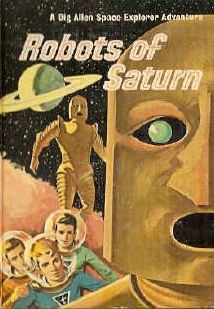
Since my pack-rat/hoarding genes were already well developed, even at that tender age, it was a big yard sale, perhaps the biggest in Chula Vista, or so my mother joked. Yes, she joked, I wept. I returned from defending the American way of life, liberty and the pursuit of happiness to discover I was destitute of all but a few of my most prized possessions -- face it, there are just some things you can't even give away, no matter how much she tried. Gone were boxes of comic books; full runs of Analog SF, Ellery Queen's Mystery Magazine, F&SF and other magazines; sets of Edgar Allen Poe, Shakespeare and Galsworthy; board games, the earliest simulation games and lots of the old 3M Bookshelf Games; and many other acquisitions of a misspent youth. Not that I blame my mom, of course...to her (and the rest of the world) they were just stuff. Among the MIA was my collection of Dig Allen, Space Explorer books. Never heard of them? You're not alone.

Back in the middle of the last century idealism had not died, nor had the idea of American exceptionalism, and when mixed with our "Space Race" against the Soviet Union it resulted in a very optimistic, very aggressive juvenile literature focused on a future that was egalitarian and progressive, yet still retained much of the rugged individualism admired by Theodore Roosevelt. Penned by veteran writer Joseph Greene and published by Golden Press, the adventures of Digby "Dig" Allen, Space Explorer took place in a solar system that, although impossible with today's knowledge, was scientifically feasible: Venus was a jungle planet, Mars was habitable and the "twilight zone" of Mercury could be colonized. The six books which comprise the series were published from 1959 to 1962, and I remember as late as the 1970s debating that the surface of Venus could possibly be a sea of petroleum -- wouldn't that have been a downer for OPEC if true?

1959
1960

For the times, the books were plausible, and they were very exciting. Of course, juvenile series were nothing new -- the Stratmeyer Syndicate had for decades produced the likes of Nancy Drew, the Hardy Boys and others. In fact, it was hoped this new series, with its focus on space, the new frontier would be even bigger. Unfortunately, that was just not in the stars.
1961

1961

1962


Instead of hundreds of titles, we have only these six, although there is a rumor that Greene may have scripted a seventh that was never published. The books just did not sell as well as had been hoped, not enough to justify further investment by the publisher. Golden Press cut its losses and went on to other projects.

1962


Though I don't know what the print runs were, they were not large. That is why, now, if you want to collect this series, as short as it is, doing so will cost some coin. Between the Internet and EBay, you can track down anything, and it's no different with the Dig Allen series, though it may take some searching. And when you do find your copies, try not to let your jaw hit the ground. For a decent copy, it may be around $50 or so, which is rather steep considering what books in other kid-lit series can be had for. Of course, it depends upon your motivation.


Now, there is an afterword to this mawkish little foray into my lost past. Years ago, I was browsing through the Chula Vista Book Store (now long gone, unfortunately) when I spied the spine of a familiar book. I reached up, pulled it from the shelf, and was thrilled to see it was a copy of Lost City of Uranus, the sixth and final book in the series. I could start to rebuild. I called the Wife over and launched into an overlong and tedious description of the series, the plot, and why this book was important to me. As her eyes glazed over (even those who love me are not immune), I told her, "I had this book when I was a kid." She wandered off, some sort of self-preservation urge, I guess, leaving me with my new found treasure. I opened the book. Inside, written in a childish hand was...

Ralph Vaughan
Telephone: GR-4-1107


Sunday, October 9, 2011

The Golden Age of Reading


The more I consider, the more strongly I tend to believe the Golden Age of Reading was 10. At that point in my life, I had all the mental tools needed to read any book, the inquisitiveness to search out the meaning of what I did not quite yet understand, and the quality of vision to be equally dazzled by the old and the new, for to me they were the same thing.


Of course, I write here of another time, another culture, when schools actually taught the reading skills needed to excel, when books and magazines of all sorts were easily available with even the most modest allowance (mine was very modest -- I haunted thrift stores where old comics were a nickel and pulps a dime), when parents could purchase a set of encyclopedias without having to sell the first-born (lucky for me, but selling the second-born would have been okay), and the youth of the time had so few other distractions -- just sports, trouble-making and that flickering silvery screen called television.


Now, don't get me wrong. Back when the dinosaurs ruled the earth (as my children and their children believe) was not an idyllic time for the prolific reader. No time has been -- hey, don't get your nose caught when you close that book; you have to forgive my son but he swallowed a dictionary when he was young; we have an odd number of people, so to make the teams even why don't you go read a book; you're book-smart, but dumb at everything else. As today, the reader has to persevere against all sorts of unkind remarks from friends, family and jackasses...some thing just don't change.


People do not change, and are just as good and evil as they have ever been, but society has changed around us. Some, like me, are not very good at adapting ("change is bad"), but most other people seem to the proof from which Darwin always searched. Nastiness, duplicity, mendacity, sloth, irresponsibility and brutality are now survival skills; so, also, are manual dexterity, multitasking, memorization of processes, and an ear for technical jargon. Me? I just read and write, and I'm not bad at arithmetic, problem solving, and connecting the dots -- not exactly the survival or advancement skills they used to be in business and civic life.


Not only has reading taken it on the chin due to social changes, but reading just for the sheer pleasure of reading has  been kicked in the jewels by all the distractions of the modern world -- television is now in color, hi-def, 3D and has 900 channels; computers and the internet can consume literally thousands of hours of your time and give very little in return; social networking can give you 5,000 BFF, all who want your attention; the death of faith and the rise of fear causes many people to engage in endless vapid social rituals; rather than read, people zone out with i-pods in their ears, like the ubiquitous shells in Fahrenheit 451; and  the would-be reader is not even safe from the government as Michelle Obama and other intrusive do-gooders urge you to get up and dance your fat away. 

As a kid and young person growing up when all the obstacles to having time enough at last to do all the reading I wanted, the ultimate wish-fulfillment episode of the original Twilight Zone was the one in which Burgess Meredith happened to be down in the bank vault (reading during lunch hour, of course) when The Bomb hit. No more boss, no more wife, no more co-workers, no one at all to keep bank clerk Henry Bemis from engaging in that one activity that made life bearable -- reading. Not even the death of civilization could stop the little man from rising to the top of the evolutionary heap; suddenly, when all else had been taken away, reading became the one activity which could keep Mr Bemis sane, keep him from putting a gun to his head. In a nuclear flash, Mr Bemis was transported to a golden age of reading and he had the enthusiasm and vigor of a ten year old. I was shocked speechless when he broke his glasses, and felt such pity for the abject little man such as I have for no other person, before or since. Now that I have big thick trifocals I think I identify with poor doomed Mr Bemis more than ever.

When I think about how the golden age of reading was 10, at least back in that age before others felt they knew best how to live my life, I wonder about the readings habits of the contemporary youngster. Is he reading? Possibly not, but if he is, it may be little more than required reading at school, the sort of didactic stories and essays chosen by committee, the "right" sort of reading designed to produce a more tolerant, more malleable child. Books are being yanked right and left from school libraries by officials who are as well-meaning as they are fearful of responsibility, and political action groups such as CAIR are seeking to remove books from private ownership. Take out A Study in Scarlet, the first Sherlock Holmes story, because it might offend Mormons; remove Little Black Sambo to keep from offending Jesse Jackson, never mind that tigers come from India, not Africa; destroy all the books by Joseph Conrad (colonialism), Edgar Poe (morbid!), and the writings of the Founding Fathers (dangerous). Instead, give that ten year old books like the execrable Skippyjon Jones series, the tolerant Bernstein Bears, and The King Who Wanted to be a Queen. Golden age? Not of reading or anything else it seems.


The Golden Age of Reading is no longer 10.

Today's youth do not read for pleasure, only by assignment, and only from approved books.

The encyclopedia has been supplanted by Wikipedia, dictionaries by Merriam-Webster.com, and big books by little screens.

By the way, folks, Kindle is evil.

And change is still bad.
(first posted on "The Hopeless Bookaholic")