Showing posts with label mysteries. Show all posts

Monday, January 22, 2018

Killing Cousins, and More

I read a few chapters from a book, then move on to another, a dozen or two per day, e-books and real, but not always the same books day to day. Others are confused when I explain my reading habits, but I never get confused about who's who or what's happened when I return for another few chapters, even if some days or weeks have elapsed since my last trip into that fictional realm. Yes, fiction is not at all like real life, where I find myself confused most of the time.

My only rule is not to read two books by the same author at the "same" time. Recently, I found myself reading two books by different authors, Beware of the Dog (A Virginia and Felix Mystery) by E.X. Ferrars and Twice in a Blue Moon (An Inspector Henry Tibbett Mystery) by Patricia Moyes. Both books are set in England and both are murder mysteries, but Beware of the Dog is an amateur detective mystery, told by Virginia of her sleuthing husband (estranged and not entirely trustworthy), while  Twice in a Blue Moon is a police procedural, even if the point of view is that of a character slightly removed from the actual investigation. What tied the books together and what set me to pondering was their theme. Both involve inheritances and long-separated cousins. I won't reveal spoilers in case you want to read the books (both are excellent), but let's just say that when it comes to cousins, blood may not be thicker than water. I thought back over other books and stories I've read, films and television shows I've seen, and realized that when it comes to crime fiction it pays to be wary of one's cousins.


Cousins usually don't fare well when they make appearances in crime friction. As you can see from the samples above, some writers just can't resist turning "kissing cousins" into "killing cousins." It's a good thing titles can't be copyrighted. Whenever a cousin turns up in crime fiction, it's a good idea to keep an eye on him, and cousins in such books would be well advised to sleep with one eye open. I'm not sure why mystery writers are so hard on cousins, but it may be because they're not often as close as siblings, sometimes not much better than strangers. It may also speak to motivation because cousins don't seem to find their way back into the fold till money comes into the picture, as in the case of both books that set me thinking about cousins in mystery fiction. Prodigal cousins are dangerous, but murder may be in the offing if you get too many cousins gathered in one place, as in this classic from Douglas Browne:


Considering how often the Grim Reaper visits cousins in mysteries, or how frequently the hidden killer turns out to be long-lost Cousin Roger, whom no has seen since Uncle Darby and Aunt Joan emigrated to Australia years ago, it's odd there is no specific word for killing one's cousin. I was greatly surprised when I searched for such a word and came up short. But I did pick up some grimly fascinating linguistic gems along the way. 

Almost all "killing" words end in -cide, from the Latin for "kill." For example, there's suicide, the killing of one's self and homicide, the murder of a person. We also have wives who kill husbands (matricide) and husbands who kill wives (uxorcide), as well as parents who just can't stand the kids anymore (filicide for son or daughter, prolicide for both), deadly siblings (fratricide for killing a brother, sorocide for a sister), and even nepotcide when it comes time to get rid of the not-so-favorite nephew when disinheriting is not enough. A murderous guest or host can do each other in with hospiticide, and you can eliminate that annoying senior citizen in your life with senicide. You can kill bees with apicide, not to be confused with apricide, which is killing a boar. And when I goof around, doing nothing in particular, I'm committing chronicde, killing time. But, as unbelievable as it may seem, there is absolutely no word in the English language for killing one's cousin, so I propose "cognicide," from "cognata," Latin for cousin...or am I guilty of linguicide -- killing language?


Thursday, June 1, 2017

When Science Fiction Died

I rarely meet people I knew when I was a teenager, but when I do, they usually ask me, "Are you still reading science fiction?" When they knew me, I was usually engrossed in a novel by Asimov or van Vogt, or reading the latest issue of F&SF or Galaxy. I was also the kid who took off from school (with the principal's permission) to attend such events as a lecture by Rod Serling and a writing workshop with Ray Bradbury. I think they thought I was defined by what I read...and they were not far wrong.

Prior to the turn of the century, my answer was a forceful affirmative, which they found amazing. In their own lives, they had moved on from youthful pursuits, strayed from the paths that defined them. The musician became a dental assistant, the marine biologist a financial manager, and the math whiz a cashier at the local big-box store. Any hobbies they had as teens had also fallen by the wayside. And yet there I was, nearly four decades on, still reading science fiction, still being defined by cosmic literature.

Nowadays, however, my answer to the question is, "No, not much anymore." As the Twentieth Century began to unwind to the Year 2000, there came a sea change in my reading. The first rumblings of it took the form of a novel called Darwinia.


I read this book a year or two before the world moved into a new century. It came to me via the Science Fiction Book Club and was the last "new" science fiction book I read. In any fictional account, a "suspension of disbelief" is necessary, but it is absolutely vital in the science fiction genre. About three-quarters of the way through the book, during a particularly epic description of the galactic archive, I thought: This is just ridiculous. My disbelief in the book's universe was no longer suspended. In fact, it came crashing down.

I really can't entirely blame the book, and the writer not at all -- Robert Charles Wilson is a talented and imaginative author. No, the fault was, as Shakespeare might have said, not in the book but in myself. When I set aside the book (I did finish it) I thought about the SFBC bulletin from which I had ordered the book -- it had been the only book even remotely intriguing to me in amongst the graphic novels, fantasy trilogies, "message" books, and authors I'd never heard of. That set me to thinking about how all the science fiction writers I liked were either dead, had stopped writing, or were trying to write for a new, younger, more callow demographic. So, I stopped reading science fiction.

Not entirely, of course, for I do find novels in the sub-genres of Alternate History and Steampunk that interest me. But the names are unknown to me. Sometimes, I'll pick up a magazine from back then and compare it with a current issue of Asimov's or Analog (the market has gone from dozens of magazines to three) -- in the older magazine, I'll recognize 90+% of the names, maybe one name in the new magazine. Same with anthologies. When I go to a bookstore, a trip through the science fiction section is an exercise in frustration and confusion, and an urge for nostalgia.

Nowadays, my usual reading fare in fiction are mysteries. I especially like novels from the Golden Age, but there are many current novelists who entertain me -- Michael Connelly, Christopher Fowler, and Stephen Puleston. Occasionally, I revisit science fiction, but the author is usually long dead or forgotten by the brash young savages of today. Even science fiction fandom has outpaced me, becoming mired in activism, political agendas, revisionism and literary tyranny of all kinds.

The world changes and the people in it. Even the Pole Star changes every 26,000 years as the Earth orbits the Milky Way Galaxy. But not me, I think.

Friday, May 5, 2017

This...Not This

Recently, I read and reviewed a book titled Uncommon Clay. I had looked forward to it, because I had read and enjoyed books about the author's other series character. Unfortunately, everything I liked about the other character and the author's storytelling were not in this new book. It's not a unique situation, liking one book from an author, while avoiding another. Usually, for me at least, it's not a matter of an author writing a bad book as much as it is...it's just not my cup of tea.

For example, there's Agatha Christie...

This
This

I'm an avid reader of both the Hercule Poirot mysteries and the Miss Marple mysteries. In my younger days I gravitated more toward Poirot than Marple, but as I've aged I find a much greater appreciation for Miss Marple and her ability to view the world through the lens of a village. On the other hand, Christie's tales of the mysterious Mr Quinn don't appeal to me at all. They are well written and cleverly plotted, and yet they leave me meh.

Not This

And Ellery Queen...

This
Not This

Early on in my mystery reading life, I discovered the Ellery Queen novels, though it took me awhile to figure out that the detective and the writer were two different people, then a little longer to discover that the writer was indeed two separate people writing under one name. I devoured the Ellery Queen/Ellery Queen novels, yet when it came to the Ellery Queen/Drury Lane mysteries I was not enthused. The same hand was at work, the same cleverness in plotting, and the same snappy turns of phrase, and yet...meh.


And Rex Stout...

This
To tell the truth, when I was much younger Rex Stout's tales of corpulent detective and orchid fancier Nero Wolfe did not appeal to me. I generally gave them a pass. Eventually, I came to my senses, and now my affection for him rivals that of what I feel toward Sherlock Holmes. Yet even when I came to admire Stout's writing skills, his superb characterization and clever plotting, I found myself cool toward his other series characters, female PI Dol Bonner and rustic Tecumseh Fox. Once again, the same hand and yet no enthusiasm on my part.

Not This...
...Or This


And even Sir Arthur Conan Doyle is not exempt...

Definitely This
Possibly This


My enthusiasm for the Sherlock Holmes tales was an early development and started when I saw the Basil Rathbone films from Fox (Hound of the Baskervilles and The Adventures of Sherlock Holmes) in the late Fifties or early Sixties. Almost immediately, I discovered the books in the library and read them all. And re-read them. And continue to re-read them. As to Conan Doyle's other non-Sherlock Holmes books...well, I am not alone in this one. It regularly arises in Sherlock Holmes societies around the world, the question of just how much attention should be paid to the writings that lie outside the Canon. There is some consensus that his spiritualist scribblings are not worth pursuing, but what about his Professor Challenger books and historical novels? The answer runs the gamut, of course, but, for me, I've read and mostly liked the Challenger books (no re-reading though), but the historical novels don't hold any attraction for me. They just don't.

Sorry, Sir Arthur...

I'm sure I'm not alone in this odd bias. For me, I think the reason is to be found in the characters themselves rather than in the authors' writing. They become friends to me, companions of a sort as I journey through a literary landscape. In a sense, they almost become real. Just as it happens in our day-to-day lives, we meet numerous people, some we like, some we don't and some who leave no impression upon us at all, and they, too, are all products of the same Author...art imitating life

Monday, August 3, 2015

There's Something About Honey

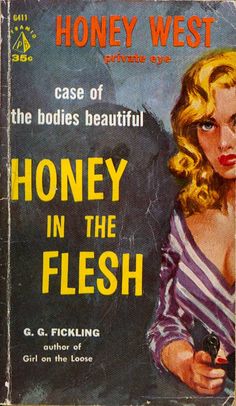
Honey West was one of the first female private eyes to grace the small screen, and she was one of my first celebrity heartthrobs. Looking back, it's difficult to say which made a bigger impression on my young mind, Honey West or the imported Emma Peel of The Avengers. Fortunately, since one is domestic and the other foreign, I can say it's a toss-up, just like I don't have to choose which car was cooler, Honey's Shelby Cobra Convertible or Emma's Lotus Elan. Since they were both black belts in Karate, either one could have been my bodyguard. On the other hand, Honey did have a pet Ocelot, and how cool was that? Honey West did have an advantage with me that Emma Peel did not, in that she was initially a literary character, and for a book person that is always something to consider. Also, Anne Francis, who played Honey West, also had an advantage (with me) that Diana Rigg did not--I was already smitten with her from Forbidden Planet (she almost upstaged Robby), and we shared a birthday...always go with a Virgo.

The television version of Honey West started on a second season episode of Burke's Law (another of my favorite mid-Sixties TV shows) entitled "Who Killed the Jackpot." There we met not only Honey, but her man-Friday Sam Bolt (played by John Ericson) and her pet Ocelot, Bruce. Honey must have made an impression with viewers and producers alike because two writers from Burke's Law were told to develop a stand-alone show for Honey, which premiered on ABC in September 1965. It's funny how some things can make an impression far beyond the reality of the situation. Seen through the prism of memory, Honey West had a long run, was a reason to tune in every Friday night at 9 PM, right after The Addams Family (yet another of my favorite mid-Sixties shows). Alas, such was not the case. Honey West endured but a single season, a mere 30 episodes, killed off by two factors--the cold equations of the Nielsen Ratings put it behind Gomer Pyle, USMC (of all things!) and ABC's moguls decided it was cheaper to import The Avengers and run it in the time-slot. (Philistines!) Well, if I couldn't have Honey, at least I could watch Emma karate chop the villains.

Fortunately, Honey West the literary character had a longer run than her television avatar, beginning in 1957, ending in 1972, at least for novels written by the original authors. I came a bit late to the party, not reading my first Honey West novel until the Eighties, and I started with This Girl for Hire, which was the first novel in the 11-book series. Here's a list, for the collector:


This Girl for Hire (1957)
Girl on the Loose (1958)
A Gun for Honey (1958)
Honey in the Flesh (1959)
Girl on the Prowl (1959)
Kiss for a Killer (1960)
Dig a Dead Doll (1960)
Blood and Honey (1961)
Bombshell (1964)
Honey on her Tail (1971)
Stiff as a Broad (1972)


I discovered that Honey West of the books was not only tougher than her TV counterpart, but sexier too. Somehow, she always managed to lose her swimsuit top or her blouse or her dress, and yet she always managed to retain her honor and her virtue. She was very much the equivalent of the shining knight of detective fiction, the private eye able to walk the mean streets without becoming mean. In that respect, Honey West reminds me of Philip Marlowe, but she also calls to mind Edgar Rice Burroughs' Martian Princess, Dejah Thoris, who never wore anything but a battle harness and weapons (illustrators are not allowed to get it right) and yet always remained clothed in virtue and righteousness. Pity the poor fool who ever mistook Honey for either an easy frail or a damsel in distress.


The books were written by Gloria and Forrest (Skip) Fickling. Technically, the byline of GG Fickling is not a pseudonym for they were Gloria's initials and surname, yet it is because they both wrote the books, especially the first two or three. According to Gloria, Skip did most of the writing starting with Honey in the Flesh, with her contributing plots and characters. Those readers coming to the series and expecting to find the television show might be disappointed. No Bruce the Ocelot and no high-tech 007-like gadgetry. There was also no man-Friday Sam Bolt; instead, we have Lt Storm from the Sheriff's Office, who was more antagonist, rival and frustrated rescuer than helpmate. Still, you have Honey, and that is quite enough. The books are well worth the effort to track down, at least the original ones...there are some modern books with the Honey West character brought back, but since I haven't read any, I can't say anything about them. By the way, if you like the mix of murder and breezy humor that was a hallmark of the Honey West books, then you'd probably also enjoy Richard Prather's Shell Scott series of novels, which have a similar approach to crime solving.


Sunday, March 22, 2015

Stories Told Around the Campfire

Beneath Strange Stars, a collection of tales from
40+ years of writing, presenting stories in
various genres, in both print & e-book editions
Click the highlighted text for links
Recently I gathered together more than two dozen (out of 300) short stories into a collection titled Beneath Strange Stars: A Collection of Tales. A couple of the stories had their start in the late Sixties and early Seventies, a few of much more recent vintage, but most hailed from the Eighties, Nineties and Naughts, when I went through a creative period where I was finishing a short story, many in various series, every few days. Here is my introduction to that collection:

Concerning Stories Told Around the Campfire

It’s all about the stories.
And the characters who live in them.
And the readers who live through them.
Regardless of cultural conventions and popular sayings, the job of Storyteller has to be at least the third oldest profession. First came the Hunter who tracked and slew Dinner, then the Cook who made Dinner palatable and something to look forward to; then, as the tribe sat around the campfire digesting Dinner, the Storyteller rose and told of spirit animals, great heroes, and beings who danced upon the mountaintops with footfalls of thunder.
On the other hand, it may have been the Hunters would not go out until the story of the Great Hunt had been painted upon the cave walls, which would make Storyteller the oldest profession, the Hunter second. And the third oldest profession? That would be the unsuccessful hunter who returned to the cave and chucked a spear into the Storyteller’s chest – the first Critic.
Telling stories is somewhat less dangerous these days as we sit around the campfire that is our sun, though, of course, one must still be wary of Critics, dodging the slings and arrows of outrageous reviews. Most writers seek fame and/or fortune but find neither, and almost all fall by the wayside, disappointed or burnt-out. Only two kinds of writers continue to write year after year – those who prosper and achieve a kind of fame, even if only as a frog in a small pond, and those who persevere simply because they cannot stop writing.
I am not the first kind of writer.
And I’ve not been the first kind of writer for a long time,
Some kids played baseball or basketball; I told stories, much to the chagrin of parents and consternation of teachers. Even before I learned to read, which I did at an early age (Uncle Bob was well-intentioned but his reading aloud of comic books left much to be desired), I told stories, which meant convincing other kids that a monster lived under the woodpile, or that a dinosaur had wandered down Seventeenth Street in National City at midnight, or that the Victorian house we all passed twice daily to and from Highland Elementary was haunted.
The first story I remember writing, where I made a conscious effort to employ such literary devices as plot, characterization and dialogue was “The Mouse in the Haunted House,” written in first  grade, a standard haunted house tale with all the usual weird goings on, but told from the viewpoint of the mouse who dwelt therein.
I thought it was a pretty good story. Mrs Hamilton, my teacher, was not so sure, and thus began trips to the school psychologist (all the rage in the Fifties for the misunderstood youth of America). Well, I did call her “Horrible Hamilton,” so, looking back, maybe I would have ended up in that office anyway.

Valiant Defenders Fighting Horrible Hamilton
AKA me in First Grade
       My next foray into fiction, a much more serious attempt, was a couple of years later, as part of a class assignment. Mrs Decker (we had no pejorative terms for her because she was a wonderful teacher) showed a series of photographs and asked us to choose one and write a short story.
The photo that impressed me was of a pure white bird with bright red eyes. As soon as I saw it, the plot for a story flashed into my mind, and the result was “The White Raven.” Yes, ravens are black, I know it now just as I did then, but the story was about a white raven, and the plot not only revealed why he was white and had red eyes, but also explained that shadowy building seen in the background – yes, another haunted house.
Mrs Hamilton would have sent me to the school shrink, or sent a note home to my mother, or both, but Mrs Decker was a much more perspicacious person. She entered the short story into a district writing contest and it won first prize.
Using photos and art as sources of inspiration is a technique I’ve turned to many times in the six decades since I saw “The White Raven,” either photographs and paintings by others, or drawings of my own. I often sketch characters and scenes and keep them near me while I write. In high school, this visual technique was adopted by Mr Phil Ligon, my journalism, photography and creative writing teacher, and we used Pictures for Writing by David A. Sohn as an unofficial textbook.
  

During high school, also, I wrote a story called “On the Moor,” about a publisher motoring through the misty wilds of Scotland who comes to a bad end. The story is not important (and it’s probably a good thing that it is mostly lost) except in that it started a chain of events that affects me even now. I had typed it on my Remington Quietwriter and was reading it in homeroom class one day. Mr Robert Vigil noticed I was not frantically trying to finish homework assignments from the day before (yes, I was one of those students) and he asked to read what I had written.
I was hesitant. I am at heart very shy, a trait most writers seek to overcome. A few years ago, I attended a social gathering at the San Diego Public Library for local authors. It was very crowded and you could not go anywhere without bumping into either an author or his ego. A few were my age or older, but most were younger, adept at networking and socializing, both on- and off-line. The way they aggressively worked the room, trying to hustle copies of their own books and forge relationships, you would have thought the room was filled with editors and publishers rather than desperate writers.
My experience is that most writers are extroverts, and those who are not Big Names are often driven by a kind of desperation that will make them buttonhole and glad-hand any possibly useful stranger not fast enough to get away. When I attended the World Fantasy Convention in Tucson (1991), I had the great pleasure of seeing the room worked by a master of the art, my friend, the late t. Winter-Damon, with whom I worked on a few projects. No editor, publisher or writer could escape him. When I remarked on his outgoing nature to his wife, Diane, she laughed and said: “Yeah, Tim can work a room like a two-dollar hooker at a Shriner’s convention. You can bet he’s going to end up with at least a half-dozen contracts.” It’s an enviable skill.
But I digress. At the time Mr Vigil asked to see the story, my private writing was still a private matter. But he was a pleasant person and asked nicely, and I did not feel he would ridicule me, which is every young teen’s second greatest fear. So I let him read it. When he saw me the next day, he handed the story back, said he had liked it very much, and asked me, “Have you ever heard of a writer named H.P. Lovecraft?”
I had not, but I soon would, and that long-dead fantasy writer would eventually loom large in my life and writing. Through high school and college, and on into adulthood, I read and re-read Lovecraft’s stories, eventually branching out to the other writers of his era, as well as modern writers also under his spell.
About that time Mr Vigil asked to see “On the Moor,” I was encouraged to apply to the local paper, the Chula Vista Star-News, as a book reviewer. Publisher Lowell Blankfort was looking for a hip student’s point of view at a time when the counter-culture was in full swing, but what he got instead was me. I sent him some sample reviews, he liked what he read, and I was hired. Well, “hired” is a relative term since there was no pay, but I did get to keep the books.
Publication in the Star-News brought a kind of notoriety, and people who had overlooked me started to notice I was alive. But I kept writing the reviews anyway. Back in those days, newspapers were still very big, especially community newspapers like the Star-News. Everyone in Chula Vista subscribed, if only to keep up to date with high school sports.  The Star-News (founded 1882) is still around, but, sadly, time has not been kinder to it than any other local paper, though it manages to maintain a kind of faded glory. Because of my book reviews, I was asked to work on the Trojan Trumpet, the school newspaper, which led to formal journalism training, photography and creative writing.
All those activities taught me about writing, but even more about publishing.  I started submitting stories to science fiction and mystery magazines I had been reading for years, but not with much success, though I was able to place articles and poems with smaller journals. There were more than four dozen major digest magazines publishing science fiction, fantasy, mystery, horror and detective stories, and many dozens more little and literary magazines. Of course, that was then, for now there are three science fiction magazines and two mystery magazines, and even they are not what they once were.
Even in the waning years of fiction (I didn’t know it then, but I do now) I published regularly, even though mostly in magazines familiar to just a handful of people. While publications like The Writer, Writers’ Digest and Writers’ Marketplace played a big role in submissions, smaller publications like File 550, the Gila Queen’s Guide to Markets, and, most especially, Scavenger’s Newsletter played an even bigger role.


Scavenger’s Newsletter was founded, published and edited by Janet Fox (1940 – 2009) a wonderful writer of fantasy and horror who also excelled as a teacher and poet. Though we never actually met, I almost feel as if I had known her.
If it had not been for Janet dutifully publishing market lists month after month, many of the stories in this book might never have been published. As with other aspects of the writer’s life, the marketzine has been overtaken by the digital age, and though such lists come at us now with the speed of electrons rather than the pace of a trudging mailman, it’s just not the same.
Because of the influence of Lovecraft, I wrote lots of Cthulhu Mythos stories, some slavishly chained to Lovecraft’s archaic and formal style, others in my own developing voice. The Mythos story that finally made a splash was actually a hybrid tale, “The Adventure of the Ancient Gods,” which appeared in a fanzine called Holmesian Federation. Other tales mixed Sherlock Holmes with Star Trek, but mine brought Holmes into contact with Lovecraft’s alien gods. Since the background of that story has been explained in other venues (Sherlock Holmes: The Coils of Time & Other Stories and Sherlock Holmes: Cthulhu Mythos Adventures), I won’t go into it or its sequels here. One outcome of the story and its sequels was that I was profiled in “Ralph E. Vaughan: Visionary of the Dreamlands,” written for Shoggoth by t. Winter-Damon.
  
Where HP Lovecraft of Providence
first met Mr Sherlock Holmes of 221b Baker Street, London
My friend t. winter-damon actually made me seem
interesting in his interview of me and review of  "The
Dreaming Detective."

It is often harder to sell a second story to an editor than the first, but usually easier to sell the third, even though in the small press world “sell” does not always equal money, and finding a little magazine that actually makes it to the third issue can be difficult. The profile in Shoggoth was a huge ego-boost, but it also caused some editors to look at my stories a little differently when they sailed over the transom. It was never easy submitting a story, but in some cases it became not as difficult.
Just as my drawings revolve around themes and archetypical characters, so do my short stories. In themes, we have alienation, alternate history, ancient cultures, religion, fear, corruption and the feeling of being lost. For my characters, I created Mitsuko, a young woman running from a warlord in an alternate Japan; Kira, a bronze-clad warrior living at the end of the Bronze Age; Tawa of the Sky Clan, a paleo-Indian maiden taken from her home by raiders; and a bevy of loners dwelling on a dead Earth at the end of time.
Before you head off into the stories, let me tell you a tale about Kira, who was my favorite. I started writing about her back in the early 80’s, a tall, muscular woman clad in black leather and bronze armor, a follower of the Triple Goddess, a holder-on to old ways even as the world changed around her, bronze giving way to the new metal iron. Her world was based solidly in the Bronze Age, but was also touched by magick and the gods. With her, I traveled to the edge of the known world and beyond, to America, Australia, Africa, the Orient, the vast necropolis of Nordhelm, and even to the far future. She was a popular character, and I drew many drawings of her in leather skirt and armor based on Mycenaean designs, with her  boots and her weapons historically accurate. I thought we would be together for a very long time, for I had written a score of stories and had ideas for many more, including several novels.
Then Kira went away.
I had suspected the end was coming, for I had seen signs, but it was still shocking when it finally happened. Editors began rejecting the stories. Finally, I received a note from an editor with whom I had never worked, and I knew the end was at hand: 
   
Dear Mr Von: Not a bad story but you can
do better than copy Xena: Warrior Princess,
can’t you?

I was annoyed at the way Xena knocked my Kira series for a loop,
but I got over it...and, no, I did not sue. Seriously?
 

     I did not submit any further Kira stories after that. Kira could prevail against any foe, human or supernatural, but not against the power of  television.

******************

The only thing to add to what's written above is that shortly after I posted a link to the e-book edition on my high school class' Facebook page, one of my former classmates provided me with Mr Vigil's phone number. Shortly afterwards, the Wife and I had a nice, long visit with him. His house is filled with books, as is fitting for a man who has loved literature and reading all his life (it's my excuse too), but I am glad his house had room for one more book, the autographed copy I gave him. I think he was please to see it and very surprised that he had had such a great affect upon my writing life, especially since he only had me for homeroom. I think all teachers hope to have a positive effect on their students' lives, but, quite often, they never know exactly what the effect was or how significant it turned out to be, for time severs us from those we knew in our youth, and seeds planted sometimes require years to bloom. I'm extremely grateful I had the chance to let Mr Vigil know his efforts had not been in vain; I regret, however, that I was not able to tell Mr Ligon the same thing, for he passed away some years ago.

Thursday, March 14, 2013

Anthology Hounds


Novels sell very well, and most commercial fiction (i.e., it pays the bills) is in the novel format. Collections of short stories by established writers do not sell as well, but they are bought by fans. Anthologies generally do not sell very well at all, and when they appear they are usually targeted to a specific sliver of the reading public -- Sherlock Holmes fans, Lovecraft fans, ghost story fans, locked-room murder mystery fans, and the like; anthologies not ensconced in a specific genre are aimed at academic and library audiences. Despite the relative poor sales figures for anthologies, they are still edited and published for an ever-dwindling audience that yet appreciates the short story, endangered species of the literary world. I always wondered what to call those of us who still like diving into anthologies, and finally got an answer a few weeks ago when reading Bennett Cerf's introduction to his 1945 Modern American Short Stories anthology:
The cheering knowledge that this book is intended solely to provide amusement for the reader, and that there is no thought whatever of providing a textbook or pretentious "survey of the short story in America," permitted the editor to range as far afield as he liked in his choice of contents. This will explain at one time the inclusion of certain stories that are decidedly unorthodox and the omission of a few trusty warhorses reprinted so often that inveterate anthology hounds can recite them in their sleep.
Anthology Hounds? I think that's a pretty apt description of our literary mentality. If you know anything about the dog world (if you don't like dogs, you might as well tell me you don't like books either so I can shun you with a clear conscience), you know the hound holds a special place among breeds in that they "track or chase the quarry sought," and they do not give up until they find what they are looking for, whether it's a duck, a raccoon or an escaped convict trying to lose a posse in the bayou. On the other hand, Coonhounds and Bloodhounds may not be quite as tenacious as Anthology Hounds.

I find myself reading anthologies quite often, but I rarely list them among the books I read and review for GoodReads.com. Except for certain anthologies (Steampunk and The Great Detective: His Further Adventures were the last two), I rarely read them all the way through. I'm in for three or four stories, then on to something else, but I always know I'll be back, over and over. But even finishing an anthology means little, for a good Anthology Hound will always return.

It would be a fool's task to make any kind of a "best anthology" list. A hundred people assembling a list of the top ten anthologies would quickly discover they had a hundred different top-ten lists, no prospect of compromise, and fights to the death would quickly break out. However, I want share some anthologies that I've truly enjoyed; maybe you could do the same.

I recall quite distinctly buying Healy & MacComas' Adventures in Time and Space in 1962 at the National City Swap Meet. It was one of several dozen used books on a rickety wire spinner (do you recall those?) and I got it for a dime. It was a hot clear blue day but as I sat at one of the tables where food was sold and started reading, the sky darkened and became full of stars, a rocket ship dropped out of space, and its descent was watched keenly by the last surviving member of a race that had hunted all other life on the planet to extinction. It's an amazing collection of stories, which I have now in hardcover and which I still delve into from time to time. First published in 1946, it collected the best of the science fiction published up to that time, stories which still remain as relevant now as they were back then. All of the stories made something of an impact on me back then (and most still have that power) but several stand out. There is "Black Destroyer" by A.E. van Vogt, the story referred to above, "The Sands of Time" by P. Schuyler Miller in which time comes around and we end up chasing ourselves, "Nightfall" by Isaac Asimov in which a planet that has never known night experiences starlight for the first time, Harry Bates' "Farewell to the Master" which was filmed as the less effective The Day the Earth Stood Still, van Vogt's amazing "The Weapon Shop," and Lewis Padgett's menacingly humorous "The Twonky." Despite the passage of time and innumerable anthologies published since then, it remains a colossal achievement. I might even go as far as to say it's the best SF anthology ever...but I don't want people to throw things at me.

Both these great Treasury of... anthologies (each a 2-volume set) came to me through book clubs, the Science Fiction Book Club and the Mystery Book Club.  Back in those days, to get the introductory offer you listed your choices, taped your dime to the response card, mailed it, and got your swag in a couple weeks. The clubs still work much the same way as they did, but, as you might guess, the dime is history. Although the genres are different the anthologies were produced at about the same time, cover the same period of American & British writing, and have similar formats -- a mix of short stories and novel-length tales, an advantage of being spread over two volumes. That there is some genre crossover between the two anthologies is hardly surprising as mystery and science fiction have always been kissing cousins.

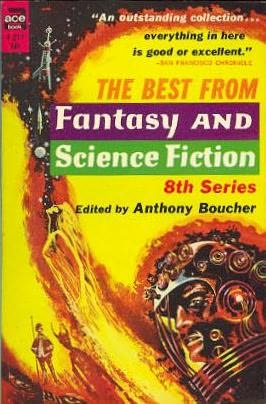
For years and years, I bought each volume of the annual F&SF best-of anthology, even though I was a long-time subscriber and had all the stories already. While I did not always agree with the editor (who does?) the stories were always of the highest quality. F&SF was hardly the only magazine to issue annual best-of collections, for in those days the newsstand was packed with digest-sized (sometimes larger) fiction magazines, and many could be counted on for collections, if not annually, then at least once before they went to magazine heaven. Some that stick with me are Galaxy's and Analog's several books, the If Science Fiction Reader, the annual collections from Ellery Queen Mystery Magazine and Alfred Hitchcock Mystery Magazine (not to be confused with the anthologies edited by Alfred Hitchcock himself), the Amazing Stories anthology, and Fantastic Magazine's. All the magazines (even those not producing anthologies) were fertile breeding grounds for stories to be later found in one or more of the many best-of-the-genre collections issued every year, and some of my favorite series were The Best Science Fiction of the Year, Star Science Fiction Series, The Annual World's Best SF and Year's Best SF.  The mystery genre also had its best-of collections, such as the annual Edgar anthologies issued by the MWA, which were always unusual because they rarely restricted themselves to a single year. Genre magazines are now, unfortunately, almost gone and no longer play a major role in filling the two remaining best-of mystery and science fiction anthologies. If you look through the copyright pages (I always do) of Otto Penzler's Best American Mystery Short Stories or Gardner Dozois' The Year's Best Science Fiction, you will note that the inclusions come from just about everywhere except genre magazines.


As the magazines began to die off, we saw a rise in anthologies containing fiction written specifically for the particular series (for example Universe), usually at the invitation of the editor. While there were several original-fiction anthologies in the 60s and 70s (and almost all genre anthologies are now comprised of nothing but original fiction), the one that has to stand out in everyone's mind, not just because of the quality of the stories but also the  attendant controversies, is Harlan Ellison's Dangerous Visions (1967)


As many people have said over the years, "The table of contents reads like a Who's Who of science fiction in the 1960s," and it's a statement no one can reasonably deny. None of the 33 stories in the book had ever appeared in a magazine, but many of them never could have been published in a magazine of the time. It may have been Endless Summer and Free Love in society, but magazines of the time still clung to boys clubs and twin beds -- if you read science fiction magazines, you could become reasonably proficient in time travel, faster-than-light spaceships, alien psychology and particle physics, but the birds and the bees would have just been terrestrial animals. Though time has dimmed the impact of some of these tales, I still remember quite fondly Fritz Leiber's "Gonna Roll the Bones" and Ellison's "The Prowler in the City at the Edge of the World." Ellison published  the sequel Again, Dangerous Visions in 1972, containing even more stories that could never have been published anywhere else...though of course they were published elsewhere because the anthologies had broken down the barriers. Ellison planned for the ultimate shout at the world in The Last Dangerous Visions, but it is likely destined to become the most famous anthology never published.


Of course, as mentioned earlier, everybody has a favorite anthology, a different list of best-of anthologies and justifications for the choices, sometimes having to do with the quality of the stories, the literary importance of the anthology, or the prestige of the writers included. But sometimes the reasons are personal and even peculiar. For example, I like Invaders of Earth, one of Groff Conklin's numerous anthologies, not just because the stories are great and I like alien-invasion tales, but because it saved me from drowning in a pond in the heartland of America. I'm sure you have similar stories.