Showing posts with label British Classic Mystery. Show all posts

Saturday, January 4, 2020

Transformations, Faded Hopes and the Trauma of Change

Buy in the US or UK
With Murder Amidst the Rushes, DCI Arthur Ravyn and DS Leo Stark begin their fifth adventure in the legend-haunted English County of Hammershire, and it starts with two men leaving the Mad Badger pub, walking onto the old brick bridge crossing the River Dresal, and only one returning to the pub's car park.

Arthur Ravyn has finally recovered from injuries received during the course of events related in Murderer in Shadow. And, finally, Sgt and Mrs Stark have been blessed with their long-anticipated baby, whom they have named Catherine. For once, Ravyn and Stark begin a case without the shadow of Superintendent Heln looming over them; the little fellow has been sent to Paris to attend a crime prevention conference...ah, we can only pity the French.

Each of the previous books in the series had a specific theme, and this book's is Transformations. We all look for ways to change our lives, but change is never as easy as it should be. All too often, any change we might effect has results neither intended nor anticipated. All of us has been so wracked by changes over the years, either through our own efforts or by the actions of others, that it's hard not to hold the belief that, "All change is bad." And it gets worse as we go along. What might have seemed adventurous in our salad years now seems traumatic. I have to admit, however, I am the wrong person to judge the necessity of change...these days, even moving a chair from one side of a room to another is enough to send me into a glassy-eyed stupor. Yeah, change is never good.

But, as the characters in Murder Amidst the Rushes find out, there is no escaping the whims of a cruel and often capricious universe. Some hope for relief from a wretched home life, yet have no idea how to escape. Others try to hold on to what they have, yet events beyond understanding or control take away the dreams and aspirations they had achieved. Then there are those who know what they want, think they know how to achieve those goals, and will not let anything, or anyone, get in their way. When greed and ruthless pursuit become the paramount drivers of a man's life, can murder be far behind? As Stark comes to realize, "Gold makes monsters of all men."

*


*

The book is available in both digital and print editions on Amazon. If you have a Kindle Unlimited subscription ($9.99/month and well worth it, according to the Wife), you can download it to your e-reader and read it at no extra cost...considering you're paying a subscription fee, I don't use the term "free" as others, including Amazon, do. If you have Prime, but not Kindle Unlimited, I think you can still borrow the book as part of the one book a month you're allowed.

Murder Amidst the Rushes has been out for about a month now. The response to it has been very encouraging, and it seems to have sparked renewed interest in the entire Ravyn series by those encountering it for the first time.

For those who have contacted me over the past year with comments and questions, I apologize for the delay in bringing the book into print. It has been a very difficult couple of years, marked by death, illness, surgeries and traumatic events of all sorts. Some I have handled better than others, but each new situation played its part in overcoming my best intentions. Thanks for your patience and encouragement. I truly appreciate your support.

Click HERE to purchase the entire series


Thursday, August 16, 2018

Ravyn vs Magic

The fourth book in the DCI Arthur Ravyn Mystery series, Murderer in Shadow, is now available. This time DCI Ravyn and DS Stark find themselves in the village of Knight's Crossing, where magic is an everyday part of life...and death. The search for a missing boy leads to the reopening of the Stryker Case, the murder of a family of malevolent magicians more than three decades earlier. For those who'd like a little peak at the story (best viewed full screen)...


Though the magical universe as portrayed in the novel does have some Lovecraftian underpinnings, it's actually based on "real" magical systems used by magicians and sorcerers. Though I don't write many fantasy stories, except the Kira Series and the Cthulhu Mythos stories (which I treat, really, as science fiction and/or mystery), I still conduct reams of research, to the point where less than 10% of the research actually makes it into the story. In crafting the worldview of the villagers of Knight's Crossing I used perhaps a dozen reference books, but three in particular.


Just because something isn't real doesn't mean it shouldn't be exhaustively researched. In my early years (pre-junior high school), that penchant tended to hold me back. I found it hard to write about subjects I could not describe right down to the nuts and bolts, such as time machines and faster-than-light spaceships. Fortunately, I learned I didn't have to tell the reader how to build one in order to get him to believe it was real in the context of the story. Though Murderer in Shadow is not a fantasy story, it does have some fantastic elements, especially for the down-to-earth Detective Sergeant Leo Stark.

Anyway, it feels good to have Ravyn and Stark back on the job protecting victims, nicking villains, and balancing the letter of the law with the spirit of the law. Though Arthur Ravyn would certainly downplay their importance in the scheme of things, one shudders to think what chaos their absence would cause in Hammershire County, a place where change comes slowly, if at all, the past often intrudes upon the present and old things sometimes refuse to die.

Friday, March 17, 2017

Stay Out of the Woods

If there is anything I've learned from a lifetime of watching films, it's that very few good things take place in the woods. From being stalked by the Blair Witch to attacked by blood-drinking Druids to running into the Jersey Devil, bad things happen in forests. The deeper you venture into those dark woods, the worse the dangers become, till the very trees themselves turn against you and try to suck your life force from you...that was a British film. The point is, you don't have to be named Hansel or Gretel to come to no good end when ancient/forbidden/cursed/haunted woods are involved. And it's not merely a modern motif. Storytellers have been warning us to stay out of the woods for at least four thousand years...obviously we are slow learners. In Beast of Robbers Wood, third book in the DCI Arthur Ravyn Mysteries, I add my own voice to those warning of dangers lurking among those seemingly peaceful sylvan settings.

Just outside Midriven village, in myth-haunted Hammershire County, is the vast, mostly unexplored tract known as Robbers Wood. The forest acquired that name through the depredations of notorious highwayman Ned Bly, who made his living by taking purses and heads along the Old Road. Even though his neck got stretched by Jack Ketch in 1837, his spirit still gallops the road. As if that were not reason enough to stay out of the woods (not to mention avoiding the lane that skirts the woods), there is an even older legend going back at least to the time of the Druids. A nameless Beast occasionally awakens from its slumber ("when the stars are right" of course) and takes victims back to its lair in the heart of the woods. Personally, I'd move to another village. When a girl vanishes from Midriven (only the first of several) it falls to DCI Arthur Ravyn and DS Leo Stark to investigate. None of the village old timers are betting on the detectives to survive, much less solve the baffling mystery -- what chance do two country coppers stand against the Old Gods?

If you're interested in a preview of the book, please click below:

Although Midriven and its legends are central to the mystery, it's really the characters that propel the story. We learn a bit more about Ravyn's past, as well as the crisis that has assailed Stark's life since we met him in Murder in the Goblins' Playground, but each person we meet in Midriven has a story to tell, and perhaps a destiny to meet. I hope you enjoy this and the other books as much as I enjoy writing them. Currently, I am working on the fourth in the series, Murderer in Shadow, which will center around the theme of solitude and loneliness...and, of course, murder.
To be taken to the series page on Amazon, please click here


Subscribe to our mailing list

* indicates required
Email Format

Thursday, October 27, 2016

Back to Hammershire County

A few months ago, I completed the long-held goal of writing a traditional British mystery. It was titled Murder in the Goblins' Playground, featured DCI Arthur Ravyn, and was very well received by readers who enjoy British mysteries in the "village cozy" genre. I've finished the second book in the series, again set in legend-haunted Hammershire County, and you can get a preview of it here:


Nearly forty years ago I found myself in Adams, Tennessee. It's not a well-known place anymore, except to students of the strange, but in the Nineteenth Century it was one of the most celebrated towns in the United States. It was the site of the Bell Witch incident. Despite the name, it was actually a ghost haunting. When I was there, more than a hundred years later, the town was still under the shadow of the Bell Witch. Businesses used Bell Witch-influenced logos in their signs. Not only could every single resident give detailed instructions on how to reach the original farm where the haunting took place, they all had stories passed down through the generations. And it was a fine irony that the mayor's surname at the time was Strange.


When I began developing Little Wyvern, the village at the centre of "Village of Ghosts," I took some cues from Adams, Tennessee. Anyone looking to develop a village as a ghost-themed tourist destination would want as many ghosts as possible, which would mean dragging every single family skeleton out of its closet, kicking and screaming if necessary. Secrets would be bared. All secrets. More than enough motive for murder...which is exactly what happens in the formerly sleepy village of Little Wyvern. Add in some quirky English characters, a hidden adversary, and a Warlock back after more than 350 years, and you have a mystery worthy of DCI Arthur Ravyn and DS Leo Stark from the Hammershire Constabulary.


Subscribe to our mailing list

* indicates required
Email Format

My Favourite British Author Wasn't British

Several years ago I was affiliated with the Friends of the San Diego Public Library, eventually becoming director of book sales. Most of our money, with which we funded various  projects the City saw fit to leave unfunded, came from weekend book sales. Some of our books came from Library castoffs, but most came through direct donations. I evaluated and priced books before they were added to our stock. I probably should mention at this point, and it will certainly come as no shock to anyone who knows me, that in addition to being director of book sales, I was also my own best customer, which is why I never had money for any other vices. I recall, in particular, one very large donation from a man who was moving back east and was paring down his mystery library to what he considered "the very best and most important." We got the leftovers.

The "leftovers" were nearly a hundred boxes, all packed to bursting with hardcover mystery novels, every one of them not only with a dust jacket, but with an archival Mylar book cover to protect the dust jacket. Unpacking, evaluating, pricing and shelving the books was a task for many months. As I worked, I found myself setting aside certain volumes for my own purchase. I soon noticed that nearly all the books I was purchasing were either written by British authors or were set in England. That brought up an interesting remembrance. Many of the mystery writers of my youth were British. There was, of course, Sir Arthur Conan Doyle and Agatha Christie, along with Sayers, Allingham, Tey, Marsh, Fleming, Wentworth and dozens of others. However, when I was young, my favourite British author was John Dickson Carr...the only problem was that he wasn't British.

John Dickson Carr
30 Nov 1906 - 28 Feb 1977

No, as it turned out, he wasn't British at all, but was born in Uniontown, Pennsylvania. The only other times I've been so shocked about a nationality were when I learned that Patrick McGoohan had been born in Queens, New York, and that Patrick Macnee had been an American citizen since the Fifties. Carr was taken with the same notion as was I--that the British were the best mystery writers, and he wanted to be one of them. In 1932, he relocated to England to seek fame as an English writer. And find it he did.

Although Carr wrote short stories and many standalone non-series novels, he's mostly known for three things: 1) Dr Gideon Fell, an erudite detective based on G.K. Chesterton, 2) Sir Henry Merrivale, an amateur detective with more than a passing resemblance to Winston Churchill, and 3) writing the best locked-room mysteries ever.

A lock room mystery, for those who need to know, is a story about a crime (generally murder) that takes place within a venue where the crime would be impossible. The crime often takes place in a room locked from the inside with no point of egress (hence the genre name) but it can also be an open area, such as a beach or a tennis court where the victim is absolutely alone. I always divide locked-room mysteries into two categories, those written by Carr and those written by everyone else. In the end, the locked room mystery is solved and the culprit outed, but in the very cleverest way possible.

Both Dr Fell and Sir Henry were created by Carr to solve the locked-room mysteries churning in his mind. Of the two, Dr Fell was more serious, usually tinged with morality and the supernatural, a walk down a darker path for all concerned. Sir Henry was less serious, almost comic, though his murders were just as dastardly  and the solutions just as clever. When reading Sir Henry's tales I was known to laugh more than a few times, but when reading a story featuring Dr Fell I was much more likely to look over my shoulder to make sure nothing dire was there.

As I mentioned, I mistook Carr for a British writer, for in those years all I had to go on were his writings, which often seemed more British than actual British authors. It was not until the Seventies, when he was writing a regular book review column for Ellery Queen Mystery Magazine that I read of his true nationality. Even though I was a little dismayed (I had to shed two decades of wrong assumptions), he remained one of my favorite (American) British authors, and does so to this day.

Sunday, December 9, 2012

England's Glory

"I started with a matchbox label that read Bryant & May -- England's Glory. That gave me their names, their nationality, and something vague and appealing, the sense of an institution with roots in London's sooty past. I decided that London would be the third character, not the tourist city of guidebooks but the city of invisible societies, hidden parks and drunken theatricals, the people and places I show my friends when the visit. By making my detectives old, I could simultaneously show them as experienced adults and immature children."
-- Christopher Fowler
I am tremendously attracted to any novel set in London, but especially mysteries, but what first caught my eye when I saw Full Dark House by Christopher Fowler a few years ago was the contradiction of the title. Because both my children were high school thespians (one was leaving school as the other entered, so I had eight years of it) and the Kidette is still associated with theater as a playwright, I know lots of theater terms (including "stage slap," but that is another story). I know that full house is every producer's goal, with SRO, and that dark house means there's no performance and the theater's empty. So, a full dark house...no performance to SRO?

Because I so often come across great mystery series after they have been around awhile (and then have to play hunt-and-seek) I was gratified to start with the first book in the series shortly after it was published in 2003. Here we are introduced to the Peculiar Crimes Unit, an agency started during WW2 to deal with crimes that might cause civil unrest or panic among the population. Leading it then, and now, are Arthur Bryant, London's most senior detective, and John May, who is not much less senior. Bryant and May are a study in contrasts, May being dapper and highly organized, and Bryant being anything but; May embraces technology while Bryant makes a Luddite look like a techno-geek; May employs the latest criminology and police techniques, while Bryant trusts intuition and has been known to call in a dowser or a white witch as a consultant from time to time. For some reason (can't figure out why) I'm more partial to Bryant, who has been known to say such things as "No, I don't have to be rude, but it does help to pass the time," and "I'm going to stuff my brain with information till the day I die, and take it with me." And die is what he does in this first book. Sort of.

In The Water Room (2004) we have an elderly lady found drowned in her home, her lungs full of river water, very much in the realm of the classic locked room mystery. Whereas the first book gave us hints and flashes of London's secret and hidden history, here it hits us full in he face, as we learn of layers of London history, ancient evils and rivers that flow through caverns measureless to man. Reading Fowler's book, you get the feeling that he imparting actual history to you, but the trouble is deciding what is fact and what is fiction. In his blog, Christopher Fowler has written that it's actually the more obscure and extraordinary aspects of his stories that are either real or only lightly fictionalized. When I read a book from the series, I find it quite handy to keep a copy of William Kent's An Encyclopaedia of London within consulting distance, and it doesn't hurt to have also read John O'London's London Stories.

The River Fleet--a "lost" river

Initially, the PCU does its business from offices above the Mornington Crescent tube station, a real place, then is forced to relocate to a disreputable warehouse on The Caledonian Road, another very real place. By making use of London's actual psychogeography, he achieves his stated goal or making London the third character of the triptych. Quite often, the two detectives find themselves standing on Waterloo Bridge, discussing cases as they look over the city to which they have devoted most of their lives.

The View from Waterloo

If you have not already discovered the pleasure of the Bryant & May series, you should give it a try before the list gets too long and before any go out of print. They series consists of...
  • Full Dark House (2003)
  • The Water Room (2004)
  • Seventy-Seven Clocks (2005)
  • Ten Second Staircase (2006)
  • White Corridor (2007)
  • The Victoria Vanishes (2008)
  • Bryant & May on the Loose (2009)
  • Off the Rails (2010)
  • The Memory of Blood (2011)
  • Bryant & May and the Invisible Code (2012)
In addition, there is a short story, Bryant & May's Mystery Tour (2011), which is part of the Storycuts program and available to US readers in a Kindle edition. Currently, Fowler is working on The Bleeding Heart, which should be out in 2013, and which I will certainly be looking for.


A bit of an addendum to this post and a bonus for Bryant & May fans. Christopher Fowler wrote a very short Christmas story featuring the two elderly detectives of the PCU. Please enjoy.

Monday, July 2, 2012

Sterling Silver

Patricia Wentworth
(1878 - 1961)

I first encountered Miss Maud Silver, retired governess turned private detective, at a book sale. I freely admit I had never before come across this literary sleuth, and as I read the back cover, the thought passed through my mind that she must have been patterned along the lines of Agatha Christie's Miss Marple or even Heron Carvic's comic parody Miss Seeton. But then I looked at the copyright date of Grey Mask (1928) and realized Miss Silver predated both -- Miss Marple's Murder at the Vicarage was published in 1930 and the parodical Miss Seeton did not appear on the literary scene until 1968.

The story of Grey Mask is melodramatic, very cozily English, and chocked with characters to the manor born, inheritances, star-crossed lovers, family secrets, scoundrels, stiff upper lips, mysterious masked masterminds, and, of course, Miss Maud Silver to straighten it all out, a motif for all the books that follow.

Miss Silver was the creation of Patricia Wentworth, born Dora Amy Elles, in Mussoorie, Uttarakhand, India in 1878, daughter of a British Army officer. After writing several competent but unremarkable romances, Miss Wentworth turned her hand to mysteries, just as other women (Josephine Tey, Agatha Christie and Ngaio Marsh, etc.) were doing in the Golden Age of Mysteries. Altogether, she wrote 75 novels (starting with A Marriage Under the Terror [1910], a romance set in the French Revolution), 32 of which involved Miss Silver, former governess living at 16 Montague Mansions, West Leaham Road, SW, London, who expected no better fate than a penurious existence dependent upon a tiny pension and a niece's charity...until she discovered her talent for hunting murderers.

There's something appealing, I suppose, about octogenarian women solving murder cases, plunging into dangerous situations all in a quest to bring order out of chaos and preserve society's morals. How else to explain the virtual army of old women with knitting in one hand, a magnifying glass in the other? Could it be a modern avatar of the Jungian archetype of the tribal wise woman? All I know is that the easiest way to create a sympathetic and popular character is to make her an old busybody who finds herself in the most perilous profession possible -- Miss Marple, Miss Seeton, Miss Silver, Jessica Fletcher, Agatha Raisin, the Snoop Sisters, Hidegard Withers, and even Gracie Allen (guesting in a Philo Vance novel).

Unlike Miss Marple and many of the others, Miss Silver is an actual private detective, or private enquiry agent as they are sometimes termed in England. She is paid for her work, but, of course, her real reward are the lives saved and the couples united, all memorialized in her modest flat by dozens of framed photos. 

Clients who come her way, steered toward her either by others she has helped or by Scotland Yard Inspectors Lamb and Abbott (who were, separately, two of her charges when she was an active governess), or by the Hand of Fate, often think they have made a mistake...
However she had done her hair, it would have appeared, as she herself appeared, to be out of date. She was very neatly dressed in an unbecoming shade of drab. Her indeterminate features gave no indication of talent or character. Her smooth sallow skin was innocent of powder. She was knitting a small white woolly sock, and at the moment of Henry's entrance she was engaged in counting stitches. After a minute she looked up, inclined her head, and said in a quiet toneless voice,
"Pray be seated."   --The Case is Closed (1937) 
Miss Silver knits all the time, usually for one or more of her niece's endless supply of children, but she has few other habits. She may not have the eccentricities of Sherlock Holmes, and certainly not the addiction to the 7% Solution, but he would definitely recognize and approve her methods. Whereas Miss Marple is continually extrapolating the vices and virtues of the inhabitants of St Mary Meade into the larger world, detecting by analogy, Miss Silver employs keen observation and unemotional deduction.


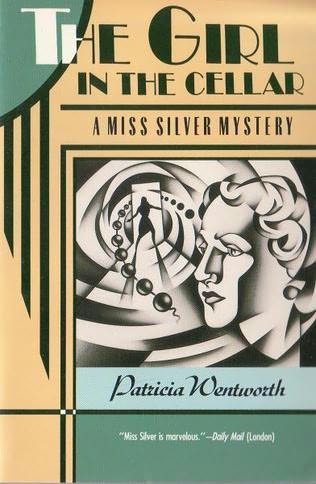
Aside for my predilection for the Victorian and Edwardian Eras, which I've mentioned elsewhere, I think one of the reasons I so much enjoy the Miss Silver series of novels is because justice is always served, and served well. Also, she is forceful and strong without being a bully, well spoken and refined without being snooty, and embodies all that is good and fair in the British Classic Mystery, an excellent representative of the the Empire. It also helps that she is always quoting Tennyson, one of my favorite poets. And like all the best detectives, she is a fixed point in time, as constant as the North Star, changeless in a tumultuous world, and ageless -- she is always the same person, from her first appearance in Grey Mask to her last bow in 1961's The Girl in the Cellar. Hopefully, this little taste has whetted your appetite for...
"...everyone's favorite spinster detective. In her black cloth coat and with her ever-present capacious knitting bag, she appears every bit the proper Victorian governess, which indeed she once was. Now she has taken on the much more lucrative occupation of private enquiry agent. Armed with the tenacious commonsense of the British and an uncanny ability to see into the very souls of murder suspects, Miss Silver is as memorable as the finest creations of Agatha Christie." (Cover blurb from the Bantam paperback editions)
If so, you might want to track down copies of Miss Silver's cases, which are quite easy to find. And unless you are into first editions (well, what book lover isn't, really?) the prices for the later editions are not too bad. To help you in your quest for completeness, I've adapted the listing from the Fantastic Fiction website, marking (*) my favorites, and including the alternate titles.

*Grey Mask (1928)
*The Case Is Closed (1937)
Lonesome Road (1939)
Danger Point (1941) aka In the Balance
The Chinese Shawl (1943)
*Miss Silver Intervenes (1943) aka Miss Silver Deals with Death
The Clock Strikes Twelve (1944)
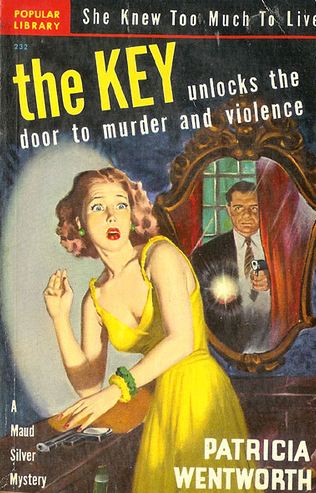
The Key (1944)
*She Came Back (1945) aka The Traveller Returns
Pilgrim's Rest (1946) aka Dark Threat
*Latter End (1947)
Spotlight (1947) aka Wicked Uncle
The Case of William Smith (1948)
*Eternity Ring (1948)
*The Catherine Wheel (1949)
*Miss Silver Comes to Stay (1949)
The Brading Collection (1950) aka Mr Brading's Collection
The Ivory Dagger (1950)
*Through the Wall (1950)
Anna Where Are You? (1951) aka Death at Deep End
*The Watersplash (1951)
Ladies Bane (1952)
*Out of the Past (1953)
*The Silent Pool (1953)
The Vanishing Point (1953)
The Benevent Treasure (1954)
*The Gazebo (1955) aka The Summerhouse
*The Listening Eye (1955)
*Poison in the Pen (1955)
*The Fingerprint (1956)
The Alington Inheritance (1958)
The Girl in the Cellar (1961)