Showing posts with label star trek. Show all posts

Wednesday, July 1, 2015

Will the Real Vulcan Please Stand Up

The second book in the interplanetary steampunk
adventures of Capt Robert Folkestone and Sgt
Felix Hand is available in print and Kindle editions
A common saying among writers and editors is that it is easier to write a first novel than a second one. When it came to writing my Great American (Steampunk) Novel, however, it was just the opposite. From idea and first words typed to publication, it took about six years for Shadows Against the Empire to come to fruition. Of course, a great deal happened in those six years, including a life-and-death struggle with a work-weasel, innumerable bouts of writers' block, several medical crises, the acquiring and firing of  a literary agent, multiple false starts, character and plot changes beyond count, and the abyss of retirement (which is not easy to adjust to after a lifetime of work). Eventually I escaped the razor-sharp teeth of the weasel, banished my inner demons (most of them), came to an uneasy peace with the people in my book, coped with retirement, and wrote the story. In contrast, the second book, Amidst Dark Satanic Mills, took about five months from idea to final draft. Personal crises aside, the main difference in the writing of the two books was that I knew my characters much better than I did on that first outing. Whenever I write a novel, I start with a character sheet on which I have mini-biographies of each person. A biography is great for consistency, such as making sure an eye-patch does not suddenly change eyes in the midst of a story or that a mechanical arm does not become a mechanical leg, but it does not really give you any clues about their personalities. In the first book, the characters grew into their roles through their dialogue, actions and reactions. By the time I reached the end of the first book, my characters were old friends. So, when it came to their second adventure, it was a reunion rather than a first date. They still surprised me from time to time, but even the best of friends can be challenging. There was a complication in writing the story, but it had nothing to do with the characters or the plot. No, it had to do with Star Trek.

Professor Lewis Swift--Astronomer & Searcher for Vulcan
While the previous book had been set mostly on Mars, Venus and Earth (London & Constantinople), I wanted the second novel to explore a bit more of my Victorian-inspired solar system, so after getting the action started on Mars and Earth (Paris), I expanded it to the Asteroid Belt and Mercury. I also wanted to take the story to a planet that had long fascinated me--Vulcan. No, not that Vulcan, the other Vulcan. What Vulcan would that be, you ask? The planet in our solar system orbiting between the Sun and Mercury. What? You can't find it? Okay, I admit it--it's not there, and maybe never was, but back in the Nineteenth Century many astronomers looked for it and a few claimed to have found it. One of the most prominent astronomers was the American Lewis Swift, whom I included as a character in the story. Professor Swift was supposed to make a cameo appearance, just enough to set Folkestone and Hand on the way to the mysterious secret headquarters of the nefarious MEDUSA organization. Well, that was the plan, but Professor Swift was so enthusiastic about discovering and naming the planet that I could hardly leave him behind on Mercury. The theoretical planet had always been called Vulcan, from the early 1800s on, but say "Vulcan" to anyone now and all they can think of is pointy ears.


Vulcan from the pulps.
Thanks a lot, Star Trek! I thought about bowing to tradition and calling the planet in the story Vulcan--let confusion reign! But I did not want the name to overshadow the plot, to, in effect, be a show stopper. Yes, I agonized over the issue. It seems silly to be so overwrought about such a small point, but, hey, that's what writers do best. Then I thought, Well, if Professor Swift wants to come along for the ride, then he can pay his way by providing a subplot which will not only uncomplicate the planet's name, but provide a little humor along the way. As it, turns out, Professor Swift was also known for naming more comets than any other astronomer at the time. In this alternate timeline, he is used to having his way in choosing the names of his comets. He feels he should have the same freedom in choosing the name of his planet, and he is not enamored with the tradition followed by the British Astronomical Society, mandating the use of Roman names for all planetary bodies. He wants to use the Greek equivalent Hephaestus instead. With a little help from Sergeant Hand (that cheeky Martian devil is always up for a bit of mischief) I was able to use the staid Professor Swift as a foil for taking jabs at tradition, officialdom and Star Trek. Having monkeyed with Planet Vulcan, I could not leave the Vulcans untouched. No pointy ears. No cool 60s hairdos. No raised eyebrows, superior smirks or vapid LLAP. Instead we have giant faceless fiery worms who drink lava and manipulate arcane energies. Take that, Star Trek!

Sunday, March 18, 2012

Are You a Fictional Character?

In the Star Trek: The Next Generation episode Ship in a Bottle, Professor Moriarty, of Sherlock Holmes infamy, seems to have escaped the confines of the holodeck and taken over the Enterprise. Of course, he has really done no such thing. Having achieved consciousness during a prior episode, Moriarty merely takes control of the holodeck computer and traps Captain Picard, Lieutenant Commander Data and Lieutenant Barclay in a holographic version of the Enterprise. In effect, they become real people (from their point of view) caught in a fictional universe by a literary character.
Taking a page from Moriarty's own book, the three officers use the transporter on the holodeck Enterprise to beam him and his paramour to yet another holographic version of the Enterprise, on the holograph's holodeck, which he mistakes for the real Enterprise; from there, he sets out into the universe in a shuttlecraft. When the Star Fleet officers shut down the simulation, they find themselves on a simulated holodeck, which they shut down to find themselves on a holographic holodeck, which they shut down to find themselves on the real holodeck, which Commander Riker has been trying to enter for hours. What of Moriarty? He now exists in a compact simulator that Lieutenant Barclay will keep "in a safe place." As far as Moriarty knows, he journeys through a real universe. As Captain Picard puts it: "Professor Moriarty has his reality, and we have ours.  But who knows? Our reality may be very much like his, and all this might just be an elaborate simulation, running inside a little device sitting on someone's table." Later, when Barclay is alone, he looks about nervously and utters: "End program." He is relieved by the non-result.


It can be quite disconcerting to be reading a book and encounter characters who realize they are characters in a book. I came across such people when I read Wilson's Illuminatus! trilogy. Because the author decided to paraphrase and skip a period during a detailed discussion between some of the characters, they  realized they were figments of a literary imagination and raised a ruckus about the writer's lack of style, poor plotting skills, and...well, they called him a hack writer. I know from experience that writers do not get nearly the respect they deserve, but, really, you expect better treatment from your own creations.

In Robert Heinlein's The Number of the Beast, we have a foursome of what appear to be pulp fiction characters who use a machine created by the Mad Scientist of the group to move to various versions of reality, or what they first accept as alternate universes -- in time, they realize what they are journeying to are actually different literary universes, and that the Black Hats who have been menacing them at every turn are really just avatars of the author; they understand that their adventures are being created by an omnipotent (though not very competent) writer at some sort of cosmic typewriter, but savvy readers know even more -- the name of every villain or antagonist is really an anagram of a Heinlein pen-name, and he had a lot of them. This is a book I've read a half-dozen times, and disliked it each time. And yet I keep going back. And I own two copies! Go figure!

In the Thursday Next series by Jasper Fforde, literature plays a central role. In fact, literature is the heart of creation. So intertwined is the world of Thursday Next, a book detective working for England's Special Operations Network, with literature that people can jump into their favorite books, and the characters of the books within Thursday's book can jump out as well. Just as the characters who enter the realms of fiction are aware they are in books, so those who escape the books are aware of their literary status. I've often found myself getting lost in a good (or not so good) book, but in the literary universe of Thursday Next getting lost in a book is taken to a whole new level. Those who enter books run the risk of changing literature, a very serious crime. I've not read all the books in the series yet, but the ones I have are very entertaining. Don't be surprised to find yourself yearning to drop in.

Jonathan Gash's Lovejoy series also uses a character who's aware he is in a book, but he thinks he's just as real as we are. Lovejoy is a divvy, a man who can sense an antique's true value, or the worthlessness of a copy, and while he's not a detective in the purest sense, he does often find himself involved with murder, larceny and perfidy. What's really disconcerting about Lovejoy is his tendency to suddenly break away from action and conversation, ignoring his fellow characters, to directly address the reader, a technique carried over when Lovejoy was adapted for television. To quote Travis Bickle: "You talkin' to me?"


Clive Cussler is not the first author to insert himself as a character into a book -- it's as old as Cervantes in Don Quixote and such modern authors as Isaac Asimov and Stephen King have done the same thing -- but no one has, I think, done it as often or as obviously as Clive Cussler in his Dirk Pitt series of books. If writing yourself into your own book was a crime (and some critics think it should be) then Cussler would be a lifer in Sing Sing. I first noticed it in Sahara -- Dirk and his companion are saved by an old coot of a prospector wandering the dunes with his burro, and of course the old coot introduces himself ("I don't like my name 'cause it's kinda funny.") as Clive Cussler. Very disconcerting! And Cussler does it time and again  -- in the wilds of Antarctica he shows up on a hovercraft; Dirk needs a classic car and Cussler provides it. This reached a peak in Dirk Pitt Revealed, which contained a short story where Clive Cussler crashed a reunion party and got to hobnob with all the characters he created...even the dead ones. So, in whom should we invest our sense of reality -- Dirk Pitt, beloved of millions and world-saver, or Clive Cussler, a now-and-then minor character? Who is more fictional?

People who love books (and if you're not one, you've probably wandered into the wrong blog) often find themselves thinking of a literary universe as real. Millions of people worldwide, for example, have imbued Sherlock Holmes with a level of reality that would have horrified Conan Doyle. And it's possible to go on walking tours of James Bond's London and Phillip Marlowe's Los Angeles. While it's one thing to give reality to a literary creation, it's quite another thing for that literary creation to take it. I mean, if it's possible for a fictional character to be real, does that not open the possibility of real people (us) being fictional? Does the true nature of world events (and the smaller events of our lives) have less to do politics and personal conflict, and more with bad writing? Is that thunder we hear, or the keys of a cosmic typewriter? Could our reality be nothing more than an elaborate simulation, running inside a little device sitting on  Captain Picard's desk?

Maybe not. But are you brave (or foolhardy) enough to shout, "End program!" Before you share the sense of relief felt by Lieutenant Barclay when his Star Trek universe continued existing at warp speed without interruption, you might consider the idea that, like him, you are just a minor character.

FINIS
(Well, not quite "FINIS" just yet...)

Updated 26 March 2012

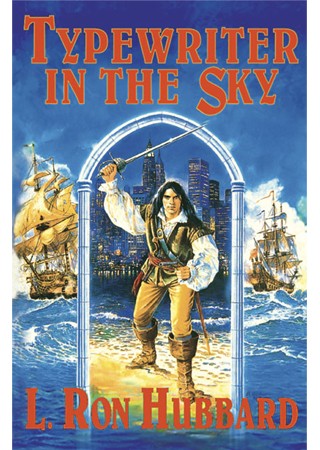
I would be quite remiss if I did not include one of the best stories in the I-am-a-fictional-character genre, Typewriter in the Sky by the late Scientology guru L. Ron Hubbard. It must have been somewhere in the back of my mind, for I earlier mentioned the thunderous sounds of a cosmic typewriter, but it leaped to the forefront of my consciousness today when I came across my 1995 re-issue by Bridge Publications. The story appeared across two issues of Unknown Fantasy in 1940, then was published in 1951 (along with another Hubbard novel Fear) by Gnome Press. The story concerns Mike de Wolf, a musician, who is visiting the walk-down Greenwich apartment of his friend Horace Hackett, a writer of pulp potboiler adventure tales. After getting an electrical shock while in Hackett's bathroom, de Wolf wakes up on a Caribbean beach in 1640; he has not traveled back in time, but has become a character (a villain named Lobo) in Hackett's latest pirate yarn Blood & Loot. Since villains do not fare well in his friend's tales, he has to figure out how to get back to the real world, surviving the perils tossed at him by the crashing keys of his friend's typewriter, the last sound he heard before being electrocuted. It's a rousing tale by Hubbard written when he was at the height of his popularity.

Thursday, February 23, 2012

"Where's the beer?"

America's greatest detective: Nero Wolfe
(Portrait by  Kevin Gordon)

Beginning with his first appearance in the book Fer-de-Lance (1934), portly Nero Wolfe has proven himself America's greatest detective. Fans of Ellery Queen, Perry Mason, Harry Bosch or Spencer will likely disagree, but I stand by my declaration. I also look to Nero Wolfe as being the source of my fondness for beer. Wolfe's first recorded words are, "Where's the beer?" Since this is more along the lines of a memoir, those seeking detailed biographical and analytical musings are referred to the excellent Trivia and Treasures from Rex Stout's Nero Wolfe Detective Stories by H.M. O'Shaughnessy.

I came late in life to the Nero Wolfe mysteries, and even later to the pleasures of beer. Both are surprising to people who know me. I've read mystery stories all my life, and was a great fan of the Ellery Queen series, even though I admit to being confused early on about whether EQ was a writer, a detective, a real person or an editor (I was an avid reader of Ellery Queen's Mystery Magazine); I was no less confused when I found out he was actually two cousins, but I eventually worked it out. I think that one of the things that put me off initially with the Nero Wolfe tales is that they are told through the prism of Archie Goodwin, Wolfe's employee who does all the legwork, chases down all the clues and rounds up all the suspects. He is glib (oftimes too much so) and has the nearly unbelievable talent of  remembering and relating the exact conversations of five or more people in a group, a skill even more valuable to readers than to Wolfe himself. Once I was able to suspend my disbelief of Archie Goodwin I was able to approach Nero Wolfe. And then I was hooked.

My lateness in developing a fondness for the taste of beer (the very cornerstone of civilization) is a bit less understandable to some people. After all, did I not spend six years in the United States Army? The charge is quite true -- sandwiched between learning spycraft and being a military photojournalist I was in the infantry, we all know how soldiers are; to top it off, for a period of time I was stationed in Germany -- beer central! While it's true I tasted beer over there, including a local brew called Hasenbrau ("Rabbit Beer" though a couple Germans of my acquaintance called it "Hasen-piss"), I just never developed  a taste, either for beer or the harder liquor that my fellow dogfaces imbibed on a (too) regular basis. After I came back to Nero Wolfe with new appreciation, I gave beer another chance.

Nero Wolfe is a gourmet, and for some people that makes his predilection for beer noteworthy, and a little mysterious. After all, wine is the beverage of the upper class, as well as the snotty people who want to be thought of as upper-crusters. I discovered that although Wolfe was very knowledgeable  about wine, he did not drink it, except, sometimes, a nice brandy that he sipped while eating Fritz's (his chef) apple pie; I don't really like wine, not since that unfortunate situation at the Fort Campbell Officers Club...best forgotten...and hard to recall, if you get my meaning, which is a good reason for avoiding wine, even during communion.

As I trekked through one Wolfe mystery novel after another (my re-introduction to the world of Nero Wolfe consisted of a bulk acquisition of nearly the entire series) I came across myriad references to his beer drinking habits -- always out of a glass, never a bottle; use of a gold-plated bottle opener to removed the caps; the beer poured into the glass in such a way to create just the correct amount of foam, which is allowed to drop to a specific level; and the storage of bottle caps in his top desk drawer so he can accurately track his daily and weekly imbibing. And to Wolfe's favorite beer -- Remmers. Often, Wolfe would be presented with a variety of beers, invariably ending up with Remmers. The brewery founded by Wilhelm Remmer in Bremmen, Germany, exported beer to the United States until the advent of the Great War; after the cessation of hostilities on 11 November 1918, exportation resumed, the company was bought by Beck & Co., but the name was retained. Unfortunately, it's not a brew I've tasted, though I do have my favorites -- MGD, Red Trolley, Bass, Karl Strauss Oktoberfest, Killians, Guinness, Sam Adams (various), Anchor Steam and Pabst. And let's not forget Romulan Ale.


There are some people who claim there is no such thing as Romulan Ale, but, you know, those are the same people who think Star Trek is fictional. Now you may think it a bit of a reach to go from Nero Wolfe to Star Trek, but not really. Had I not rediscovered the sheer brilliance of Nero Wolfe, I probably would not have discovered the great taste of beer, and though I would likely ended up in Star Trek: The Experience at the Las Vegas Hilton, I would not have found myself sitting before a "Morn's Sampler" listening to a fan sitting at the nearby counter of Quark's Bar & Restaurant trying to ask a cute little Vulcan girl (yeah, it's the ears) out on a date...yes, there are Trekkies, and then there are real Trekkies.

"Morn's Sampler" is a collection of five beers based upon the worlds and races of Star Trek: Klingon Blood Draft, Romulan Ale, Trixian Bubble Draft, Dominion Lager and Obsidian Dark...it's a lot of beer, certainly not for the faint-hearted. I must admit, however, that even the Sampler paled in comparison to the Wife's beverage of choice -- the Warp Core Breach (for two or more: "Order this drink and prepare to separate your saucer section."). We were at the time celebrating our natal days, and spent four straight days in the 24th Century, leaving only at closing time to take the monorail (the Borg-themed car of course) back to the Sahara to sleep and read and listen to the swing music of Harry Barlow in the lounge...I had brought Edgar Wallace's Scotland Yard, an E. Phillips Oppenheim tome, and three Nero Wolfe novels. I don't know if  Wolfe would have liked Romulan Ale (smuggling it across the Neutral Zone between Nevada and California can be hazardous), though I think he would have liked Obsidian Dark, but favored Dominion Lager.


Several films were made in 1930s, but they are considered minor efforts. Nero Wolfe has also appeared on the small screen twice, both good interpretations in their own right. The first was in 1981 (NBC) and starred William Conrad, with Lee Horsley as Archie Goodwin, and was set in modern-day New York City; in 2001-2001, A&E mounted a handsome production with Maury Chaykin as Wolfe and Timothy Hutton (whose father played Ellery Queen) as Goodwin, set in a New York City vaguely in the 1950s. The A&E series had better production values and was actually based on author Rex Stout's books, whereas the NBC series merely had the characters. Another thing the A&E series had which the NBC series lacked: that wonderful gold-plated beer opener.


As good as the series might have been, they are not the books, and the books are where Nero Wolfe and Archie Goodwin truly live. And where they will always dwell, for both men are citizens of the country of mind.


One last comment about my involvement with Nero Wolfe: my children (especially the Kidette) wish I had never ever read a Nero Wolfe book. I insisted they become HTRs (Human Tape Recorders) and relate to me the exact words spoken by friends, family, acquaintances and strangers. When they protested that it was not humanly possible to do what I asked, I always told them the same thing: "If Archie Goodwin can do it, so can you." I can't imagine why they were so keen to move out.

Sunday, October 9, 2011

Writing of the (original) Star Trek


The series Star Trek began in September 1966 and ended June 1969, and that should have been the end of it, but as everyone knows, it wasn't. The series, with its aging starts, returned for a series of theatrical films, followed by a second incarnation, Star Trek: The Next Generation, which was quickly joined by three television spinoffs: Star Trek: DS9, Star Trek: Voyager and Star Trek: Enterprise, along with theatrical films about the spin offs. Think of it: forty-five years have elapsed since it appeared, many of the actors have passed away, and yet we are still entranced by the characters and the actors of the original series.


Of all the people obsessed with Star Trek: The Original Series (ST:TOS), perhaps we should not be surprised that one of them is William Shatner. After all, it's been said, only half in jest, that William Shatner is Captain Kirk's biggest fan. He himself has written five books about...himself.


 In addition to his Star Trek writing, William Shatner has written an autobiography, at least up the moment he was writing his biography...I wonder if he included the writing of his biography in his biography since that was what he was working on, up to...now.  He's also written novels based in the Star Trek universe, in which he had the unique opportunity to write further adventures of the heroic Captain James Tiberius Kirk, which is, of course...himself. As much time as he has spent writing about his journey through the worlds of Star Trek, both as actor and character, I think William Shatner is last person in the world who should tell Trekkies, or Trekkers, as they call themselves, to let go of Star Trek and...get a life.

William Shatner is not alone in his fascination with himself. His life, on and off the set, was the subject of Dennis Hauck's book, Captain Quirk: The Unauthorized Biography of William Shatner; the same author also wrote the little known William Shatner: A Bio-Bibliography. Another paean to the godlike Shatner is Robert Schnakenberg's prestigiously entitled The Encyclopedia Shatnerica: A to Z.

Equally famous is Captain Kirk's first officer, Commander Spock, an inhabitant of the planet Vulcan, the son of a Vulcan ambassador and a Human mother. That "half-breed" nature was used to good effect in the original television series, as well as the later films, to examine the idea of a man as much at conflict with himself as he is with the universe around him. Because Spock is as much as outsider on Vulcan as he would be on Earth, Trekkers, especially the misfits of society, were quick to bond with this ultimate outsider. Oh, yes, and then there were the pointed ears...


Commander Spock gave fans the oft-quoted tag lines "fascinating" and "that is illogical." If I had a bar of gold-pressed latinum every time I heard (or said) those lines, especially with one eyebrow raised, I'd be richer than the Grand Nagus (if you don't know the Star Trek reference, you'll have to look it up; it's the only way you'll learn) or beyond the dreams of Quark.

As the late George Reeves (murder not suicide) came to be identified with the character Superman through his film Superman and the Mole People and the extremely popular television series, or Adam West with the character of Batman (West was passed up for a role in the racy Valley of the Dolls because he was deemed too wholesome), Leonard Nimoy became quite identified with his Star Trek character, one of the reasons he quickly accepted the role of Paris on the series Mission: Impossible, taking Martin Landau's place.

Leonard Nimoy insisted he was not a freak, that he was a real man with real ambitions, that he was a serious actor who could appear in serious roles; more than anything else, though, he wanted people to know, to admit, to believe I Am Not Spock. Well, we all knew better; we all knew who he was, and a favorite line of every fan was, "Say, isn't that Spock in that role?" The gibe came up in the cult favorite J-Men Forever!, when a character asks his partner about a Martian with a metallic hood: "Say, isn't that Leonard Nimoy?" and the partner replies "Don't know; can't see his ears." Yes, it was a clip cut from Republic's Zombies of the Stratosphere. Of course even Leonard could not deny the obvious forever, and eventually he admitted what his fans knew all along, entitling his next autobiographical effort, I Am Spock. Well, duh.

The other actors who weekly saved the universe aboard the USS Enterprise either wrote their autobiographies or were the subject of books by professional writers...though sometimes their characters took a more prominent role than the actors...

For example, James Doohan was respected as an actor, but his character, Commander Montgomery Scott, was beloved, even revered. Once, while touring NASA for the launch of the shuttlecraft Enterprise, he was approached by technicians, physicists, space scientists and other professional braniacs, who told him that they were inspired into their present position by his role as the miracle-worker of the Enterprise.

Unhura (Nichelle Nicols), the ship's communications officer, and the recipient of television's first interracial kiss; Sulu (George Takei), the helmsman and finest fencer in Star Fleet; Pavel Chekof (Walter Koenig), navigator of the Enterprise and youngster cast because creator Gene Roddenberry thought his haircut would attack young Beatles fans; Doctor Leonard McCoy (DeForest Kelly) who was known as much for his medical prowess as his rifts ("I'm a doctor, dammit, not a brick layer); and even Yeoman Janice Rand (poor, ill-fated Grace Lee Whitney) who had an unrequited crush on Captain Kirk, had their moments in print:


But perhaps the greatest fame that can be claimed by the characters of Star Trek or any television show, and an indication of how infused they have become with the consciousness of American society, is when they appeared on the covers of that iconic magazine TV Guide, published in a single week, in honor of the show's 35th anniversary:

Note to fellow biblioholics: It was hell getting all these covers the week they were published, going from store to store, enduring the smirks of clerks who knew you were one of those people. Finding them now is not impossible, but you will have to seek them through a specialist, rather than a person who deals in regular back-issue magazines. Thank goodness for the internet.